Motion Is the Real Test of AI Low-Light Enhancement
Low-light imaging has always involved tradeoffs. When there is not enough light, the camera must make difficult choices: increase gain and accept noise, extend exposure and risk blur, combine frames and risk motion artifacts, or compress dynamic range and lose detail. Add fast motion into the same situation, and the challenge becomes even more demanding.
This is where real-time AI video enhancement is moving from “nice-looking demos” to real-world engineering.
A single low-light image can often be improved convincingly. A static scene can too. But the moment the camera moves, the subject moves, or both move at once, the problem changes completely. Motion is not a small detail in video denoising — it is the core challenge.
Why Motion Makes Low-Light Video So Difficult
In low light, cameras receive fewer photons, the signal is weaker, and noise becomes more visible.
AI-based denoising handles this better than traditional ISP noise reduction because it is trained to separate noise from real image detail, rather than relying on fixed filters. But video introduces a new dimension: time.
A video denoising system must preserve consistency across many frames. Processing each frame independently may look clean frame by frame, but unstable in motion — details flicker, textures appear and disappear, edges pulse. To create truly high-quality video, the system must understand how information moves through time. That is where most of the real difficulty lies.
Local Motion vs. Global Motion
Not all motion is the same.
Local motion happens when objects inside the scene move — a person walking, a car passing, hands gesturing. Global motion happens when the entire camera moves, which is common in smartphones, action cameras, drones, body cameras, and dashcams. In these cases, almost every pixel may be moving from one frame to the next.
Global motion is especially difficult for real-time AI enhancement because the algorithm cannot assume the background is stable. A camera mounted on a helmet, bicycle, or vehicle may produce rapid and irregular motion — and in low light, that motion is even harder to estimate because the input frames are already noisy and blurred.
These are also the use cases where quality enhancement is needed most.
The Challenge of Temporal Processing
Multi-frame processing makes sense in theory: if one frame is noisy, neighboring frames may contain useful information to help reconstruct detail. But this depends on accurate alignment — and in video, alignment is complex.
Fast motion, rolling shutter, dynamic lighting, and camera movement all make frame alignment unreliable. If the algorithm misjudges motion and blends frames that don’t actually match, the result is ghosting and trails. If it blends too cautiously to avoid that, noise remains. If the model cannot distinguish noise from motion, it may erase real details or invent unstable ones.
Real-time deployment adds another layer of difficulty. The model must remove noise, preserve texture, handle motion, avoid flicker, protect edges, maintain color, and support HDR — all within the latency, memory, and power constraints of embedded hardware. A model that looks good in a lab test may not be suitable for a moving camera in the field.
What Good AI Denoising Should Do in Motion
A strong AI video denoising system should not simply make the image smoother. It should improve visibility while keeping the video natural and temporally stable — preserving real detail, avoiding flicker between frames, reducing ghosting, and maintaining readable edges and color even in dark or rapidly changing scenes— without inventing detail that was never there.
In short, good AI denoising is about understanding what should remain stable, what is truly moving, and what is only random noise. That distinction becomes especially critical when the entire scene is in motion.
The future of low-light enhancement is not only about sharper individual frames — it is about better video experiences. And solving that challenge, in real time, on moving devices, in difficult light, is exactly where the next major step in AI video enhancement begins.
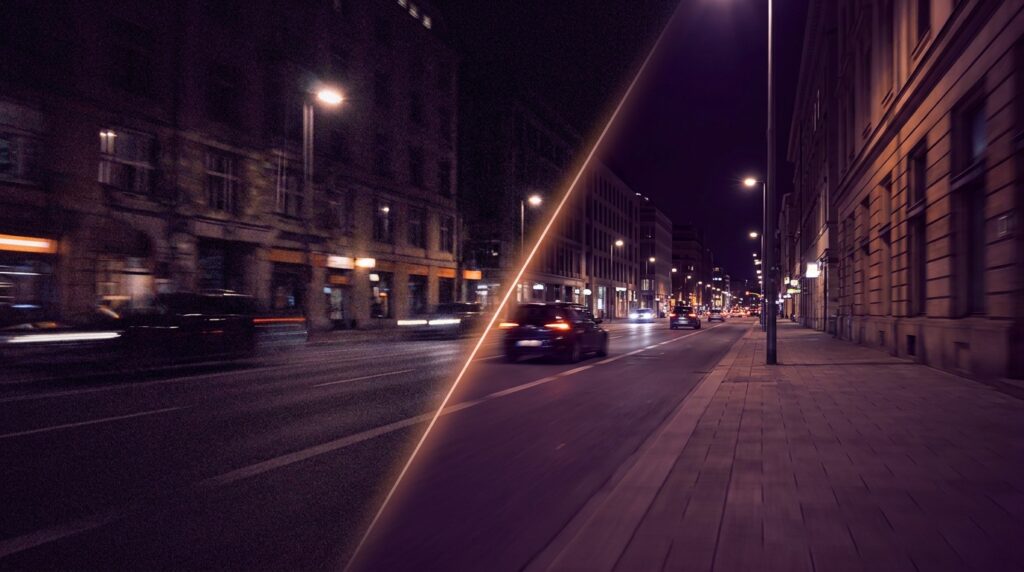
Where Visidon Fits
This is the specific problem we have focused on solving with Visidon AI Low-Light Enhancement: real-time video enhancement under global motion, in low light, on embedded hardware. Global motion is the harder case precisely because it removes the assumption most video denoising approaches rely on — a stable background — while making every added computation more expensive in power on a battery-constrained device.
Better quality and lower power draw pull in opposite directions, and global motion makes that tradeoff sharper than almost anywhere else in video enhancement. Our goal is not to pretend the tradeoff does not exist, but to shift it: more quality from the same compute and power budget than existing approaches deliver.
Our starting point has been unusually strong for this challenge. The core of our approach builds on an algorithm originally developed for security cameras operating in ultra-low-light environments — a use case that demanded reliable noise separation and temporal stability long before “AI video enhancement” became a mainstream expectation for consumer devices.
That foundation is combined with two decades of focused work on mobile camera image quality. Visidon was founded in 2006, and image and video enhancement on resource-constrained hardware has been the core of what we do since. Few teams have spent as long solving exactly this class of problem: getting more out of small sensors and small power budgets, under real-world motion, in real time.
Latest results: benchmarked against the iPhone 17 Pro
Throughout development, we have benchmarked continuously against leading devices to make sure our results hold up against the best the market has to offer. We have now completed training of our own network on footage from the iPhone 17 Pro and compared the results against the phone’s native video processing.
We chose the iPhone deliberately. Its video pipeline is one of the strongest on the market, which makes it a demanding benchmark. On the goal we set for ourselves — handling global motion — our network came out ahead.
Two results stand out:
- Low-light quality on par with a flagship. In dark scenes, our network reaches a level of image quality comparable to one of the most advanced smartphone camera pipelines on the market.
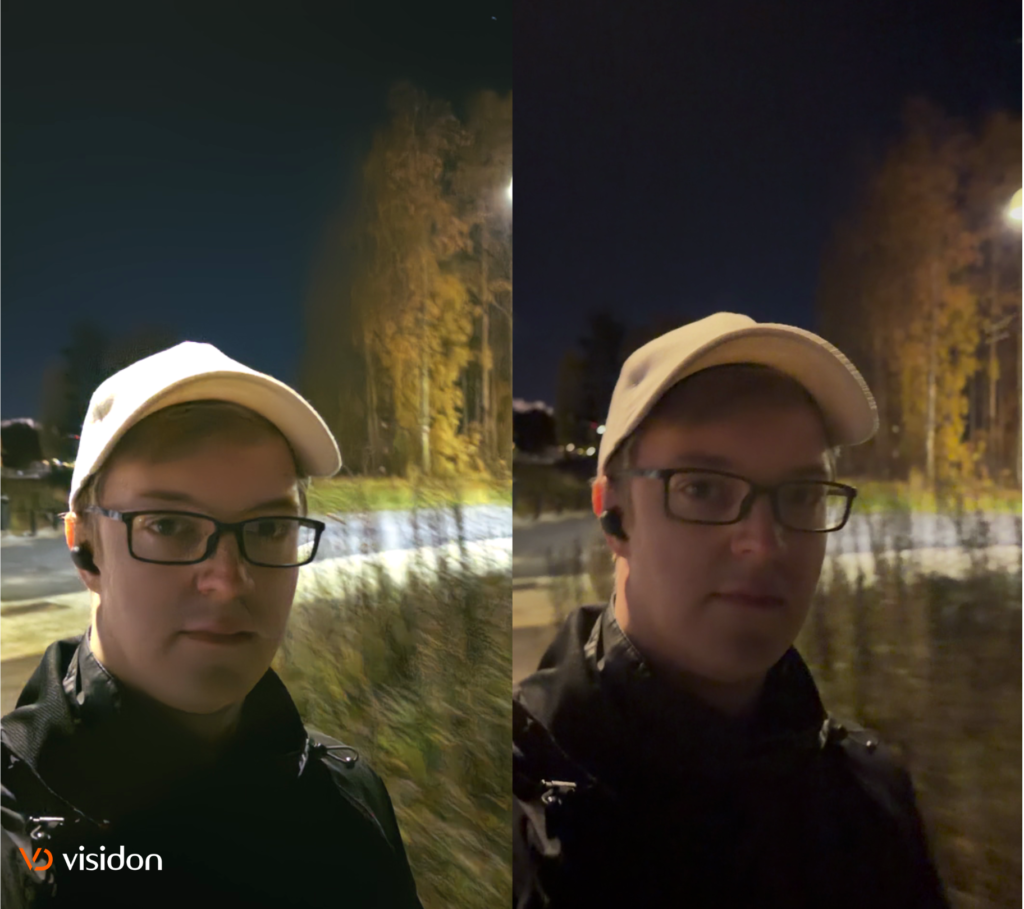
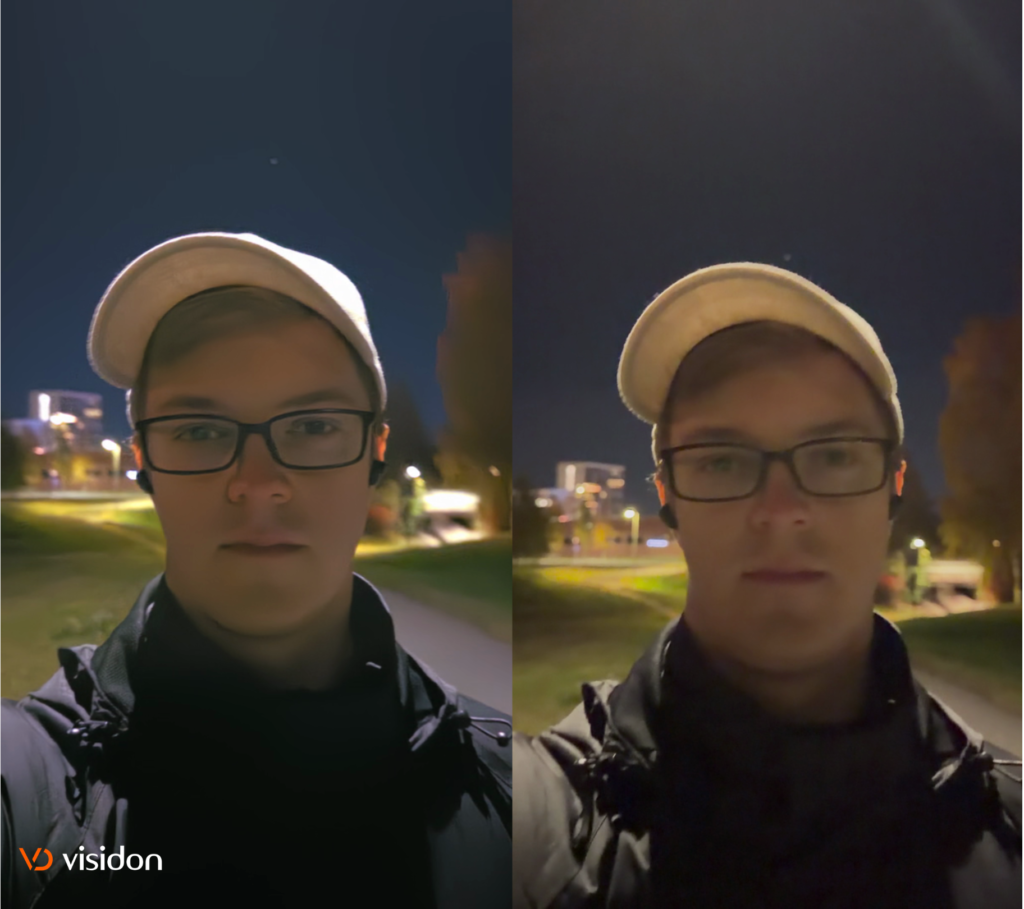
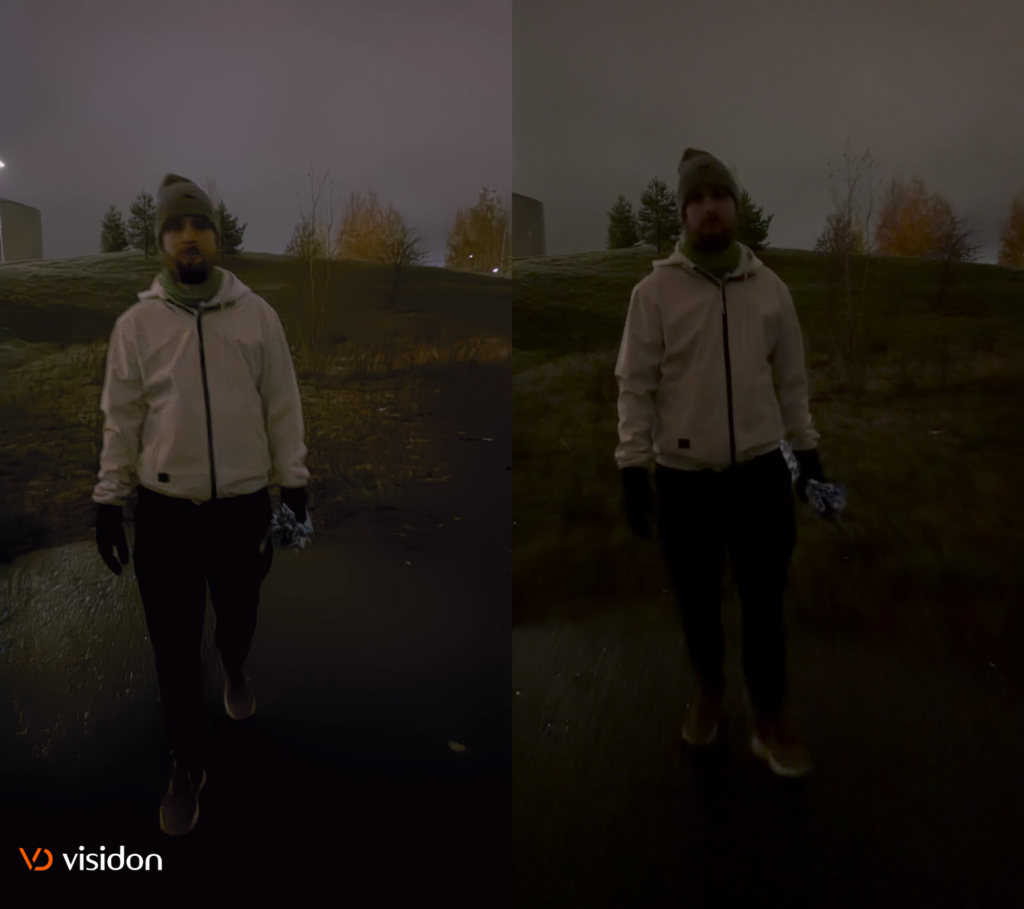
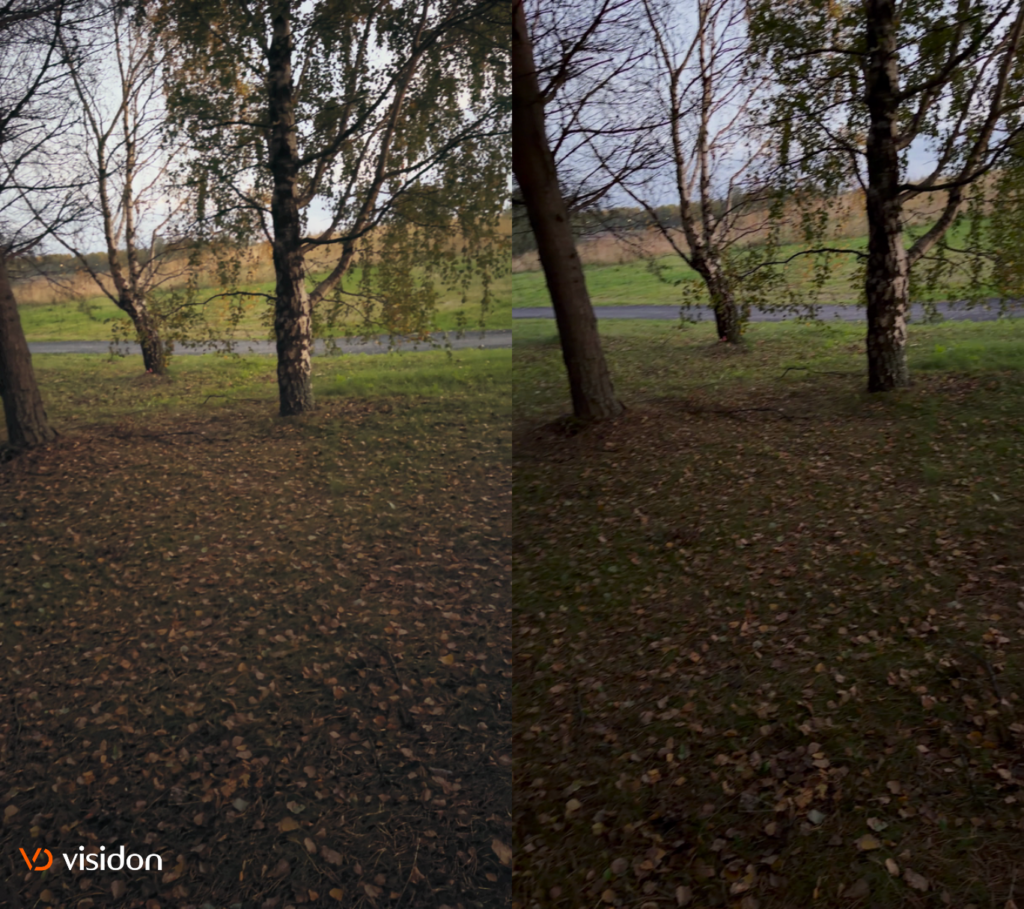
- Clearly better under global motion. Where the camera itself is moving, our network keeps detail and temporal stability better, with less smearing, ghosting, and flicker.
The second point is the one that matters most to us. Matching flagship quality in static low light is the entry ticket; handling global motion well is what sets the solution apart.
Side by side: frames from video with moving camera
Each pair shows the same frame from a handheld low-light video: Visidon AI Low-Light Enhancement on the left, iPhone 17 Pro native processing on the right.
Who Benefits
AI Low-Light Enhancement is built for devices where the camera itself moves and the light is rarely ideal:
- Smartphones — handheld video at night, in concerts, restaurants, and city streets, where users expect flagship-level results without a tripod.
- Creator cameras — vlogging and walk-and-talk shooting in mixed and dim lighting, where clean, flicker-free footage saves time in post-production.
- Action cameras — helmet, bike, and body-mounted footage with rapid, irregular motion at dusk, at night, or indoors.
- Drones — aerial video at dawn, dusk, and night, where continuous movement and long viewing distances make every detail count.
- Automotive cameras — dashcams, digital mirrors, and surround-view systems that must stay clear and stable while the vehicle moves through changing light, from tunnels to unlit roads.
Across all of these, the requirement is the same: better visibility in low light, without sacrificing temporal stability when everything in the frame is moving — delivered in real time, on the device itself.
Keywords: AI, CNN, denoising algorithms, RAW denoise, YUV denoise, RAW denoising, YUV denoising, low-light enhancement, embedded camera systems, real-time video enhancement.